
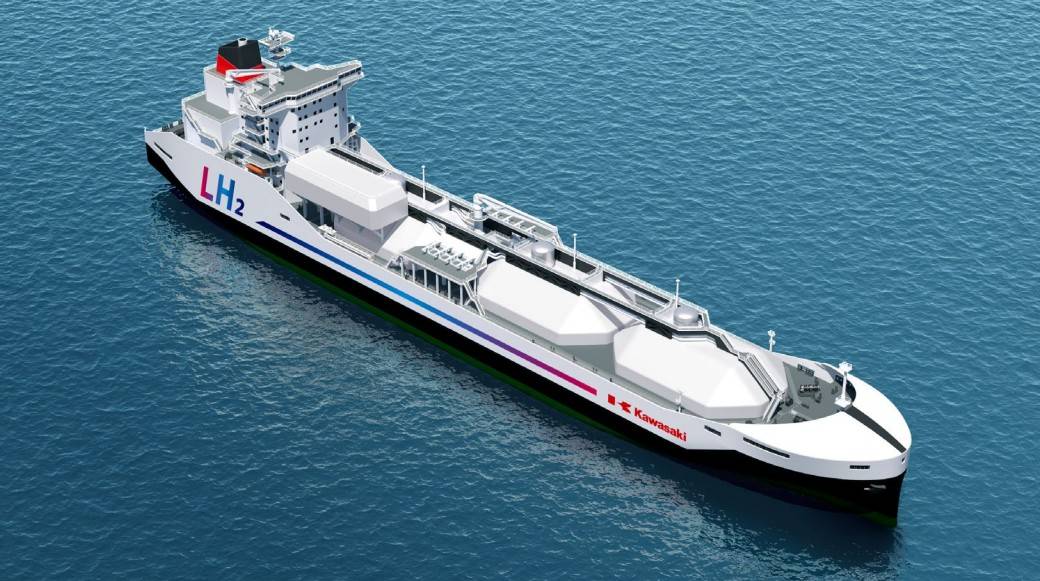
Kawasaki Heavy Industries and Japan Suiso Energy have signed a contract to build the world’s largest liquefied hydrogen carrier, marking a step toward the commercialization of an international hydrogen supply chain. The vessel will have a cargo capacity of about 40,000 cubic meters and will be built at Kawasaki Heavy Industries’ Sakaide Works in Kagawa Prefecture.
Japan Suiso Energy is the project operator for Japan’s New Energy and Industrial Technology Development Organization (NEDO) Green Innovation Fund Project, which aims to demonstrate ship-to-shore loading and unloading of liquefied hydrogen and conduct ocean-going trials by fiscal year 2030.
The new carrier is intended to serve as a foundation for a commercial-scale hydrogen supply chain, responding to anticipated global demand in the 2030s. Using the vessel alongside a liquefied hydrogen terminal under construction at Ogishima in Kawasaki City, Japan Suiso Energy plans to demonstrate operational performance, safety, durability, reliability and economic feasibility for large-scale hydrogen transport.
The vessel is designed specifically for the transport of cryogenic liquefied hydrogen and will be equipped with cargo tanks totaling approximately 40,000 cubic meters. A high-performance insulation system is intended to reduce boil-off gas generated by natural heat ingress, supporting large-scale, long-distance transport.
Propulsion will be provided by a diesel and hydrogen-fueled electric propulsion system, combining a hydrogen- and oil-based dual-fuel generator engine with a conventional oil-fired generator. Boil-off gas from the cargo tanks can be compressed, heated and reused as fuel, reducing carbon dioxide emissions during operations.
The carrier will also feature a cargo handling system capable of loading and unloading large volumes of liquefied hydrogen, using double-wall vacuum-jacketed piping to maintain extremely low temperatures during transfer between shore facilities and onboard tanks.
Hull form and draft have been optimized to reflect the low density of liquefied hydrogen, improving propulsion efficiency and reducing power requirements. The hydrogen fuel, supply and cargo handling systems have undergone risk assessment, with safety measures incorporated to protect the crew, environment and vessel structure.
The vessel is expected to have an overall length of about 250 meters, a molded breadth of 35 meters and a fully loaded summer draft of 8.5 meters, with a service speed of around 18 knots.
It will be classed by ClassNK and registered in Japan.
By enabling the stable transport of large hydrogen volumes, the project is intended to support decarbonization across power generation, mobility and industrial sectors as Japan works toward a carbon-neutral society by 2050.
Kawasaki Heavy Industries previously built the world’s first liquefied hydrogen carrier, the 1,250-cubic-meter Suiso Frontier, completed in 2021. The company has also participated in pilot demonstrations of liquefied hydrogen transportation between Japan and Australia and developed hydrogen receiving infrastructure in Japan.
The post Kawasaki heavy industries to build world’s largest liquefied hydrogen carrier appeared first on Marinelink.


